


RELEASE
ARTICLE


- Jean-Marie Pflomm, Pharm.D., Editor in Chief has disclosed no relevant financial relationships.
- Brinda M. Shah, Pharm.D., Consulting Editor has disclosed no relevant financial relationships.
- Review the efficacy of tirzepatide (Mounjaro) in reducing the risk of major adverse cardiovascular events in adults with type 2 diabetes who are at high risk for these events.
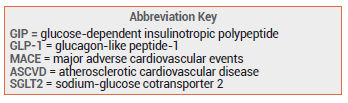
The injectable GIP/GLP-1 receptor agonist tirzepatide (Mounjaro – Lilly), which was approved by the FDA in 2022 for treatment of type 2 diabetes,1 has now been approved to reduce the risk of MACE in adults with type 2 diabetes who are at high risk for these events. Tirzepatide is also available as Zepbound for chronic weight management and for treatment of obstructive sleep apnea in adults with obesity.2,3
GLP-1 RECEPTOR AGONISTS — The injectable GLP-1 receptor agonists semaglutide (Ozempic), dulaglutide (Trulicity), and liraglutide (Victoza) and oral semaglutide (Ozempic, Rybelsus) are also approved for cardiovascular risk reduction in patients with type 2 diabetes. These drugs have reduced the risk of MACE by up to 20% in clinical trials in patients with type 2 diabetes.4
A CLINICAL STUDY — FDA approval of tirzepatide for the new indication was based on the results of a double-blind trial (SURPASS-CVOT) in 13,299 patients ≥40 years old with inadequately-controlled type 2 diabetes and established ASCVD. Patients were randomized to receive tirzepatide titrated to 15 mg (or the maximum tolerated dose) or dulaglutide 1.5 mg injected subcutaneously once weekly, each in addition to standard care. At baseline, about 30% of patients were taking a SGLT2 inhibitor (canagliflozin and empagliflozin have been shown to reduce the risk of MACE in patients with type 2 diabetes and ASCVD). After a median follow-up of 4 years, the incidence of MACE (a composite of nonfatal myocardial infarction, nonfatal stroke, or cardiovascular death) with tirzepatide in the intent-to-treat population was noninferior to that with dulaglutide (12.2% vs 13.1%; HR 0.92, 95% CI 0.83-1.01). The incidences of all-cause mortality (8.6% vs 10.2%), myocardial infarction (4.7% vs 5.4%), nonfatal stroke (3.5% vs 3.8%), and cardiovascular death (5.6% vs 6.2%) were lower with tirzepatide than with dulaglutide, but the differences were not statistically significant. GI adverse effects were more common with tirzepatide than with dulaglutide.5
DOSAGE AND ADMINSTRATION — The recommended starting dosage of tirzepatide is 2.5 mg injected subcutaneously once weekly in the abdomen, thigh, or upper arm. After at least 4 weeks, the dose can be increased to 5 mg and then further increased in 2.5-mg increments every 4 weeks to 15 mg once weekly.
CONCLUSION — Addition of the injectable GIP/GLP-1 receptor agonist tirzepatide (Mounjaro) to standard treatment was noninferior to addition of dulaglutide in reducing the risk of MACE in adults with type 2 diabetes and ASCVD, but it caused more adverse effects.
- Tirzepatide (Mounjaro) for type 2 diabetes. Med Lett Drugs Ther 2022; 64:105.
- Tirzepatide (Zepbound) for chronic weight management. Med Lett Drugs Ther 2023; 65:205.
- Tirzepatide (Zepbound) for obstructive sleep apnea. Med Lett Drugs Ther 2025; 67:29.
- Noninsulin drugs for type 2 diabetes. Med Lett Drugs Ther 2025; 67:185.
- SJ Nicholls et al. Cardiovascular outcomes with tirzepatide versus dulaglutide in type 2 diabetes. N Engl J Med 2025; 393:2409. doi:10.1056/nejmoa2505928